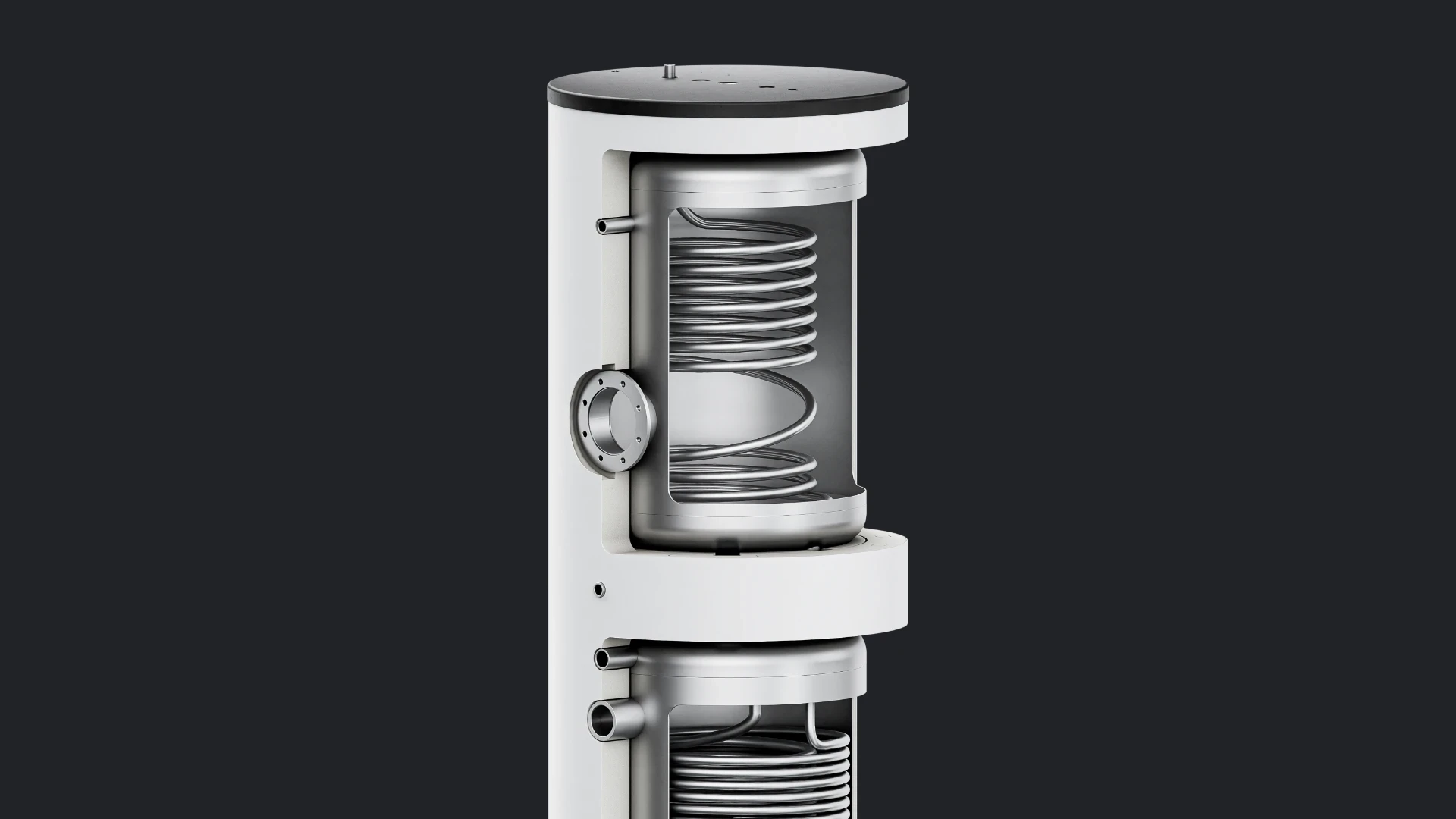
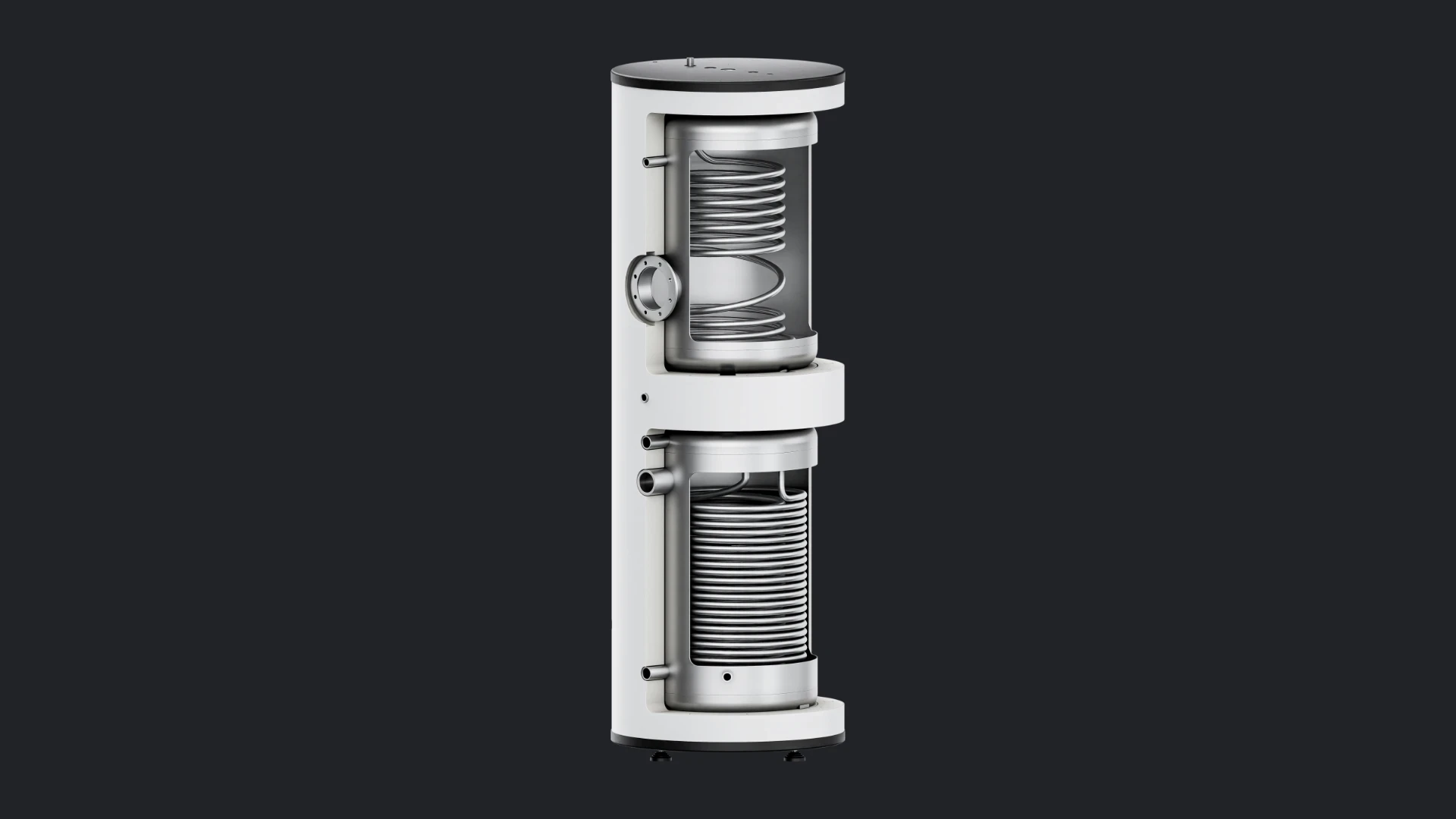
Integrated tank for heat pumps with direct refrigerant-to-water heat transfer
Norway
Project date
Introduction
Redesigned a PED-compliant pressure tank for a Norwegian heat pump system, enabling safe conversion to propane (R290), eliminating coil failures under high pressure, and supporting EU expansion with validated 70 bar destructive testing and optimized double-wall heat exchanger design.
The challenge
We first met the customer at ISH Frankfurt 2023 trade fair. The company was a relatively small Norwegian manufacturer offering innovative, integrated heating systems based on heat pumps. Their flagship product was an outdoor boiler room delivered as a compact modular unit resembling a wooden container. Inside, the system integrated a heat pump module, thermal storage tanks, piping, controls, valves, and a unique patented tank design that allowed direct use of refrigerant to heat water.
Thanks to this innovative approach, the system achieved very high efficiency and enabled rapid heating of water to significantly higher temperatures than competing solutions.
However, the customer faced a critical problem. Their existing tank supplier failed to meet quality expectations. The tanks suffered from recurring failures caused by leaks in the internal coil, which in this application operated under extremely demanding conditions—high refrigerant pressure combined with elevated temperatures. These failures represented a major risk to the reliability of the entire system.
At the same time, the customer planned to transition from refrigerant R32 (with a global warming potential of~675) to climate-friendly propane (R290, GWP = 3). Under the European Pressure Equipment Directive (PED), propane is classified as a hazardous medium significantly increasing design and safety requirements for pressure vessels.
Additionally, the customer was preparing for expansion from the domestic Norwegian market into the wider European Union. Uncertainty regarding the quality and safety of the tank—the most critical component of the system—was a major barrier preventing further growth.
The solution
We held several technical meetings with the customer to fully understand the product, its patented design principles, and the challenges involved. Based on this input, we undertook the task of redesigning the tank while preserving the critical geometries essential to the system’s performance, ensuring operational safety and regulatory compliance.
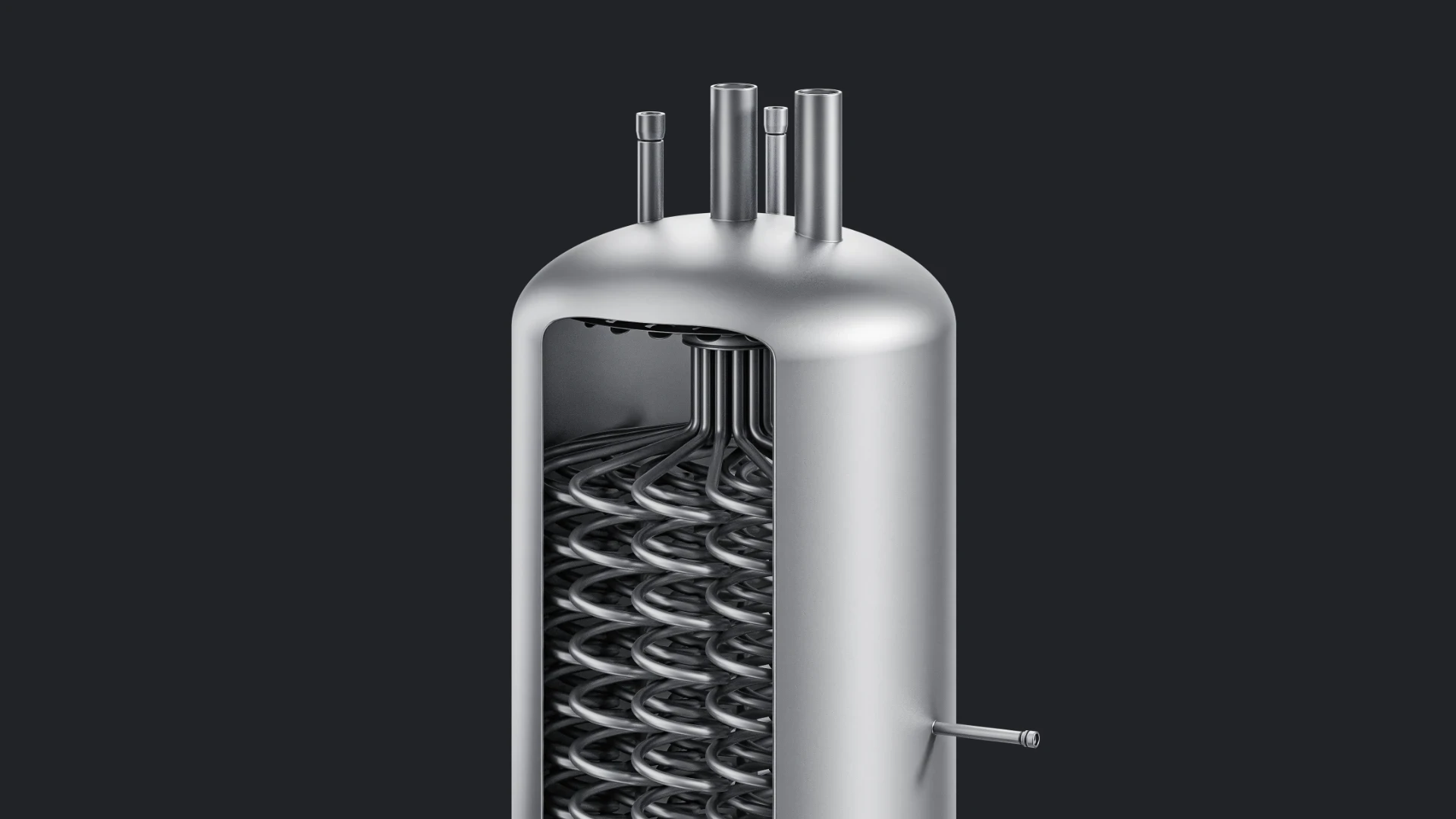
The tank was designed in accordance with the European Pressure Equipment Directive (PED), under ASME design code. For a vessel with a nominal operating pressure of 10 bar, the ASME requirements for propane demanded a destructive burst test approaching 70 bar. During the first destructive test, the tank failed at 63 bar—insufficient to pass validation.
Increasing material thickness was not an option due to unacceptable cost implications. Instead, we optimized welding preparation by tightening dimensional tolerances, minimizing weld gaps, and adjusting nozzle placement on the head to distribute welding stresses more evenly. A new prototype, manufactured under controlled conditions by a highly qualified welder, successfully passed the destructive test at 70 bar.
A separate and equally demanding challenge was the internal coil—the core of the system’s thermal performance. For safety reasons, the refrigerant had to be separated from the water by two independent barriers, requiring a double-wall coil design. At the same time, it was critical to avoid trapping air between the walls, which would act as an insulation and degrade heat transfer efficiency.
The customer developed and patented a concept based on a coil formed from tubes with a bean-shaped cross-section. ACT’s contribution was to engineer a manufacturing concept capable of executing this idea in a controlled and repeatable way, enabling simultaneous coil Winding and tube deformation as required by the design. The key challenge lay in maintaining material integrity, surface quality, and dimensional stability during the combined forming process. ACT’s solution ensured a robust and production-ready implementation of the customer’s patented concept.
We addressed this through several coordinated measures:
Using annealed tubing to eliminate residual stresses prior to forming
Slightly increasing tube wall thickness to improve mechanical strength and enhance thermal contact between inner and outer walls
Optimizing the bean-shaped deformation geometry to avoid excessive material strain
Designing and manufacturing dedicated forming rollers for controlled coil winding
The refrigerant was supplied to the tank via copper piping, requiring a reliable and corrosion-resistant joint between copper and stainless steel. While brazing is commonly used for joining these materials, ACT applied a qualified welding technology for dissimilar materials that is well established within our production expertise and capable of meeting the required pressure and durability criteria. A dedicated welding procedure was developed, with defined process parameters and personnel specifically trained for this type of joint.
To ensure long-term corrosion resistance, the stainless steel tank was fully passivated prior to the installation of copper end connections and valves, as these components would not withstand the acidic passivation process. This approach preserved material integrity while maintaining hygienic suitability for domestic hot water applications.
The results
Following the design and validation phase, the project moved into implementation. Within a few months, we began regular serial deliveries of tanks to the customer.
As a result of this collaboration:
A fully PED-compliant pressure tank was implemented, enabling the customer to expand across the entire EU market.
The system was safely converted from R32 to R290 (propane), improving thermal performance while significantly reducing environmental impact.
The previously recurring failures related to leaking and cracking coils were completely eliminated.
Production costs remained commercially viable despite significant design improvements and stricter safety requirements.
Laboratory testing and real-world operation demonstrated performance superior to competing solutions, thanks to optimized coil materials and manufacturing methods.
The customer’s satisfaction with the project led to further cooperation. We were entrusted with additional tanks from the same product line and continue to work together on new technologies, including increasingly advanced prototypes with growing technical complexity and market potential.
" height="18px" id="iWrNsKvvp" width="18px"/></svg>)
